Showing posts with label Hans Zimmer. Show all posts
Feb 26, 2011
83rd ANNUAL OSCAR NOMINEES FOR BEST ORIGINAL SCORE
Like the past three years, I'll do a short review of 4 of the nominees and a complete review of my pick of what I think should be the winner.
127 HOURS - A.R. Rahman
The story of 127 Hours is about being stuck between a rock and...well..another rock. It's based on the true events involving thrill-seeker Aron Ralston's struggle to survive after he suffers a brutal accident leaving him stranded alone in the middle of nowhere. It's not necessarily the great movie it's made out to be, as it's been tremendously overrated and pushed by studio moguls who just wanted to recreate the critical and box office success of filmmaker Danny Boyle's previous Oscar winning 2008 effort, Slumdog Millionaire.
Back to serve under Boyle's direction is Indian film composer A.R. Rahman who seems to be establishing quite a name for himself in Hollywood after his successful score and hit song "Jai Ho" for Slumdog. Like his woefully ignored and spirited 2009 score for Couples Retreat, Rahman once again proves with 127 Hours that he is not just a Bollywood composer or a flash in the Hollywood shitpan.
Rahman composes a somewhat challenging score that reflects on the euphoria, intensity and isolation that is portrayed quite profusely in the film. Rather than composing something as flamboyant as his usual work, Rahman takes a different route and creates quite an effective atmospheric score. Rahman seems to favor eccentric instrumentations over the usual score ensembles and that's what makes him stand out from the rest of the score composers working today.
The central character theme is somewhat of a urgent piece titled "Liberation", which serves as the cornerstone to the film and is broken up into three movements. Each piece gets increasingly more violent and desperate as we watch James Franco's character slowly fading away on screen. Oddly enough it shares the same gritty progressive rock qualities that Boyle's former go to composer John Murphy would have brought to the table, particularly echoing that of 28 Days Later's "In The House In A Heartbeat". While it's interesting to hear it develop more and more into frantic urgency, it never really gets off it's feet into anything worthy of award material.
The gorgeously calming "The Canyon" is without a doubt the highlight of the score. With it's thought provoking clarinet solo played over a lush string section fading in and out, it can't help but remind me of the lonely, yet lovely, theme Alan Silvestri composed for Cast Away.
Rahman ventures into disturbing territory with the hallucinogenic cues "Acid Darbari" and "R.I.P." Making use of an Indian chants and some abstract vocal laments, tinkling bells, a sustained distorted guitar in the background and some mystical sounding electronic effects that seem to act as the voice of the blistering sun.
It should be noted Rahman has also co-written and performed a song with pop vocalist, Dido for the end credits roll. The consoling and absorbing "If I Rise" is a fitting song to round out the film and a wonderful way to close the score. The messy album presentation is another story, with source songs scatter all over the place. Some good, some terrible. Either way they are sorely out of place.
The score is all right and works perfectly with the film itself. As a listening experience it doesn't add up too much but a good 17 minutes worth of 4 star material salvages it from being a complete bore.
**1/2 out of 5
INCEPTION - Hans Zimmer
Thank the sticky-floor, popcorn gods for Christopher Nolan and Inception.
For an unreasonable number of years, the Hollywood Blockbuster has been nothing but mindless and noisy eye candy inflated with pointless CGI that does nothing to carry the story and only sell toys.
Memento & Insomnia director, Christopher Nolan has changed all that with his uber-moody reboot of the Batman franchise. By investing us into solid storytelling and over the top, yet strangely believable action pieces, Nolan brings the brains back to the table of the Blockbuster, while not sacrificing any of the fun in the process.
Now Inception may not be the mind-bending complicated head-trip the average popcorn munching fanboy has made it out to be but thankfully it still asks you to keep your thinking cap firmly in place.
Playing like a mixture of David Cronenberg's eXistenZ and Alex Proyas' Dark City, infused with a heavy helping of The Matrix, Inception is a tragic love story wrapped in intricate neo-noir dream sequences and extravagant action scenes set in James Bond-esque backdrops.
With all that on the cinematic palette, composer Hans Zimmer was given a wonderful collection of ideas and statements to paint a musical picture with. Sadly that is precisely where things begin to fall short and I suspect Nolan might actually be the one to blame.
Time and time again, Zimmer has proven himself as a top-notch composer with a large resume of extraordinary scores from all genres, almost always filled to the brim with a keen sense of creativity and more than adequate instrumentations. However Nolan seems to have his mind very firmly set onto what sort of style and sound he is looking for and that would probably be why a lot of Zimmer's work for Nolan sounds like a larger scaled reworking of the director's former main composer, David Julyan.
Not to say that Zimmer's score doesn't work with the film itself, because it does to a tee. It sewn so deeply into the film that it's often difficult to differentiate what us as the viewer is hearing as backdrop music and what is part of the sound design the characters on screen can hear in Inception's world.
Now because the score is so deeply woven into the film, it suffers greatly when standing alone. It's almost like tearing out the heart and seeing how long it can sustain life without it.
Inception has a few very engaging ideas musically wise and some very bold statements are made but in the end it just falls a little short. Mostly due to constantly resorting to meandering electronically produced foggy moments that just sort drift alone without any character or development for anything that our thoughts or ears to grab onto.
One of the most impressive ideas Zimmer came up with for the dream-woven world of Inception, was the use of iconic French singer, Edith Piaf's classic "Non, je ne regrette rien" as sort of a plot device, linking the waking world and the dream world together. What Zimmer does is takes the opening bar of Piaf's song, slows it down to an unrecognizable speed, then pumps up the bass and volume, twisting it into something similar to a strikingly menacing foghorn. This fascinating and alluring motif is used to reflect on the idea that the time in the dream world passes by slower than in the 'real world'. Very clever, Mister Zimmer. Very clever indeed.
Next up, Zimmer makes use of an orchestra in such a strange manner he most definitely deserves recognition for his inventiveness with this technique. After writing short motifs and themes, he recorded them with an orchestra, sampled the recordings, then with sharp auditory manipulations and filtering, Zimmer mixed them into the new age type compositions he wrote on his synths. With this he created a very modern sounding noir-ish type score that would easily appeal to the younger generation. This approach to scoring is quite effective in some of the quieter and moodier moments of the film but for the loud, more action-oriented scenes it suffers greatly. It comes off as sounding like a symphony being strained through a pop can. It would probably lose a lot of it's impact in the film too had the volume not been turned up in the mix and the sound effects not overpowered many of these moments on screen.
Perhaps the most strangest idea was to bring in The Smiths & Modest Mouse guitarist Johnny Marr and have him play a few notes here and there. While it is welcome to see the two musicians come together on the project, Marr's work on the album could have easily been performed by anyone. It's not terribly complicated guitar work nor does it even feature any of his own compositions. They could have had Joe Blow from accounting on the third floor to play the guitar parts and it wouldn't have made a difference. In fact the guitar work is buried so far into the mix you might not even recognize it's even there.
Once again Zimmer resorts to his tiring chopping board string charges and overly simplistic testosterone pumped brass arrangements that just doesn't do it for me anymore. It was fun when he first started using this tactic but after so many years of recycling this idea and hearing many other composers today emulate it, it just becomes impotent and dull.
To be fair, Zimmer has some great moments of beauty and wonder that is actually quite rewarding. There's a sort of sublime elegance and mystery that haunts these moments with an ambience reminiscent of textures used in Vangelis' Blade Runner score.
The highlight of the entire score is the concluding cue, "Time" which in a way could be a hopeful rearrangement of Zimmer's own "Journey To The Line" from A Thin Red Line.
Hans Zimmer delivers an extremely compelling score as heard in the film, however the scores falls short on it's own with too many moments of Zimmer on action-writing auto-pilot. Although with about 20 minutes of top-notch material here, it is possible to edit together a very impressive concert suite.
As heard in the film : **** out of 5
As heard on it's own : ** out of 5
THE KING'S SPEECH - Alexandre Desplat
The King's Speech at it's core is a moving story about a building friendship based upon personal struggle and the battle to overcome it. The film follows the true story of King George IV and the conflict he endures to conquer a potentially crushing speech impediment as he's being ascended into The Throne.
The public humiliation and sadness is captured so well in the first five minutes of The King's Speech that it immediately absorbs you into this beautifully framed and delicately yet powerfully written film. The same can said about French composer Alexandre Desplat's wonderfully sublime and heartfelt score for this thoughtful little piece of cinema. When I say "little" I mean small in scale and that's precisely what enthralls you with it. The King's Speech doesn't try to overwhelm you with extravagant settings, larger than life dialogue and costumes like most films about royalty seem to be guilty of. Desplat understands this and holds back from ever becoming overly pompous or melodramatic.
Instead he opts for a very small and intimate score consisting mostly of a warm string and woodwind section led by a sole piano, likely representing the feeling of family and friendship.
The King's Speech is a delightfully light-hearted score with just a hint of sadness brilliantly merged into it's leading theme. The piano lightly taps away in a pizzicato style, taking the personification of a stutter without sounding too abrupt or disrespectful. This particular theme is what captures a certain sense of dignity quite well without ever getting too prudish or stilted. In fact it flows with such grace and warmth it easily allows you to emphasize with the characters on screen with a sense of familiarity.
The secondary theme that represents the developing friendship between the two main characters is based around a warm string section and some graceful piano playing ascending into some absolutely gorgeous woodwinds and harp. Without words it speaks so loudly and clearly of an undeniable sense of the respect and empathy the two characters have for each other.
We are taken down some darker passages as well, as Desplat reuses some of similar minor chord progressions he used so brilliantly in his submission to Harry Potter & The Deathly Hallows. Deslplat explores slight hints of dissonance and inevitable dread to creates a sense of fragility and tragedy we all can relate to.
Desplat takes some interesting approaches with the thematic material, that could have easily taken the score on a detour into the mundane and repetitive but with beautiful melodic writing he avoids that road all together. First off he almost never lets the emotions swell into overly dramatic territory, instead he steps aside and allows the actor's powerful yet delicate performances take center stage. Secondly, Desplat doesn't develop the themes at all until the very end and even then it's very, very brief. By not allowing the melodies to expand, it seems to mirror the stutter of King George IV and never rises until the speech impediment no longer controls the King.
Things are finally allowed to really cut lose for a brief moment in "The Rehearsal" cue. Both themes are cleverly interwoven with each other in an up-tempo rhythm, as a flute prances into the fold with such optimism it reminds me of some of the happier moments in Elfman's Black Beauty.
In an interesting and incredibly effective twist, director Tom Hooper and Desplat decided to use source material for the climatic scene and closing of the film. Two faithful adaptations of Beethoven's "Symphony No. 7 -II" and "Piano Concerto No. 5 Emperor II" were recorded apart from the rest of the score using a larger ensemble.
The only shortcoming I can find with this score, is a minor one but can't go unnoticed for most audiophiles like myself. Desplat decided to go for some authenticity with the recording process of this score and brought in six authentic microphones that were used by the Royal Family to record their speeches during this historical era. An interesting process but sadly the sound quality sometimes suffers in the lower reqions of the score, particularly during the moodier moments. This goes completely unnoticed on film but on album it is quite apparent with a respectable sound system.
Sound quality aside,The King's Speech is a score worthy of the recognition it's receiving and should be a staple in your Desplat collection.
**** out of 5
THE SOCIAL NETWORK - Trent Reznor & Atticus Ross
Who would want to see a movie about the internationally popular, social networking internet site known as facebook?
That seemed to be the most frequently question asked when someone would mention The Social Network, before it became a critical and box office success.
It's full of unlikable characters, shallow situations, possibly factually inaccurate and, to be blunt, it's about the creation of facebook. At first thought, you would think you'd rather see a movie documenting Bill Gates' morning breakfast habits.
All that aside, it's also scripted and paced with well-refined precision, well acted, shot beautifully and hypnotizing in a strange, pessimistic and unsettling way.
The finer points in this film would mostly be credited to the wonderfully casted performances by Jesse Eisenberg, Justin Timberlake and Andrew Garfield. As well as the admirable script from screenwriter, Aaron Sorkin, who was fresh from TV's criminally under-appreciated The West Wing and woefully canceled Studio 60 On The Sunset Strip, which was what attracted Se7en and Fight Club director David Fincher.
One of the most surprising additions to the team was Nine Inch Nails mastermind, Trent Reznor, who had been hired to score the film. Initially, he was completely uninterested about working on a facebook movie and passed on the job to enjoy some free time away from anything remotely musical and just relax. Fincher insisted that he read the script before making a final decision and much to Reznor's surprise he was drawn into the morally warped screenplay and signed on right away, sacrificing some much needed holiday time. In Reznor's own words about the film: "it's really fucking good...and dark",
With Reznor enthusiastically on board, it was time to lighten the workload a little and bring in one of his working partners, Atticus Ross, who had just handed in a reasonably impressive and atmospheric score for the forgettable The Book Of Eli, earlier that year.
After Fincher's last film collaboration with composer Alexandre Desplat on the quiet and melancholy The Curious Case Of Benjamin Button, it came as a colossal surprise to the industry and the public that the director had chosen two 'rock' composers not known for their subtly or orchestral elegance.
What the final product proved, was that Reznor and Ross are fully capable of handing in a score worthy of the buzz it's received.
Using a combination of '80's pop sounds, modern synth textures and moody atmospherics, Reznor & Ross created a fascinating 'wall of sound' with layers of interweaving sound design and rhythms.
The album comes off as almost a continuation of Nine Inch Nails' daydreamy instrumental album 'Ghosts'. In fact it even goes so far as to rearrange two tracks from that record for the final score.
The composers manage to capture the modern insane hell that the film paints and the timid, social awkwardness of facebook creator, Mark Zuckerberg into just a few simple descending piano notes heard in the main theme at the beginning.
Breaking the ice with an off putting stuttering drone, much like Hans Zimmer's theme for The Joker in The Dark Knight, then smoothly introducing a few lonely piano notes at the forefront, reflecting that of Zuckerberg's alienation and ironic inability to function in social situations.
The main theme is heard only a few times throughout the film but by the end, the piano is buried under layers and layers of distortion and noise, it's almost as if it's supposed to emulate Zuckerberg's emotions being engulfed within the legal and relationship Hell he's created for himself.
Apart from this single theme The Social Network doesn't really have a thematic voice to attach itself to but rather a textural one filled with electronic blips, waves of uncomfortable sound and some catchy beats to boot.
With all these wonderful moments on the album it has to include just a few instances of almost laughable silliness as well.
At some points you could almost swear it's going to break into an inane dance number with some cheesy robotic voice telling us to "dance around the world and back".
On another track you almost expect to see Top Gun's Maverick appear over the horizon after the big jet-fight and everybody cheers.
Normally I would say these blunders aren't the composer's fault as they are just writing for the specific scene but there really aren't any definitive scenes in this film that would call for such dippy musical numbers.
Perhaps the most absurd moment on the album is the duo's synthetic rendition of Edvard Grieg's classical jewel "In the Hall of the Mountain King". It's like they decided to rearrange the piece for the Super Nintendo and drain it of all it's original impact. It's very much like Wendy Carlo's classical synthesized hack job on A Clockwork Orange soundtrack, only it plays no purpose in the film or the specific scene it's attached to. It's completely pointless and is quite frankly incredibly distracting.
When it all comes down to it, Trent Reznor & Atticus Ross' contribution to The Social Network is a brave accomplishment for all parties involved. After working with such celebrated composers as Howard Shore, Elliot Goldenthal and Alexandre Desplat, I'm sure it took a little courage for David Fincher to involve Reznor & Ross and request such an untraditional score.
There are many weak moments in the album and it does become tiresome after about 50 minutes but the talent can't go unrecognized and if these two keep on working on it, they could be well on their way to becoming accomplished score composers.
I'm happy to see avant-garde scores like this and 2009's The Hurt Locker get recognized by the Academy, rather than the usual traditional score. Whether or not they're actually being noticed for the thought and work put into the music or just the films they are attached to, doesn't really matter to me. It means the general public are taking notice and quite frankly is somewhat amusing to see these scores create such silly, bitchfest squabbles on snooty film score discussion boards.
Should it win (or won, like it did) the Oscar? I don't think so. There are two other scores I think are more deserving but Reznor & Ross do deserve the attention and will hopefully keep on working in the film business to eventually prove themselves worthy to even the snobbiest of film score fan's ears.
I like this.
*** out of 5
Dec 17, 2010
82nd ANNUAL OSCAR NOMINEES FOR BEST ORIGINAL SCORE

AVATAR - James Horner
Avatar. Where to begin?
It's not one of the greatest cinematic achievements of our time, like Hollywood would like you believe. Nor is it one of the worst films made, like bitter internerd fanboys would like you to believe either. It's simply an evenly told adventure story, that tries a little too hard to preach eco-issues to the audience. Visually and technically, Avatar is simply astounding. Story and character wise it's a little dry, but it's to be expected and therefore can be forgiven if it's just a wild romp that you're seeking out. All that aside, it's James Horner's colorfully exotic adventure score that's in the spotlight here.
At first, I dismissed the Horner's score as nothing but a retread of his previous efforts and other composer's works that explored the realms of other planets and cultures. In a way, it is, but it's done with such masterful intelligence and thought, that all else is forgotten.
Horner's third collaboration with the equally egotistical, director James Cameron, is a fine one indeed, littered with some of Horner's most obvious and overused motifs and themes, which should come as no surprise to the film score community or fan of the composer's earlier work.
While the composer spoke of irregular instrumentations and textures rarely ever used in scoring procedures, nothing really stands out as being groundbreaking or original, but in all fairness, it's so well done it almost doesn't matter.
There are interesting moments of synth textures blended in seamlessly with orchestra or a tribal vocal and/or percussion section, that the regular listener probably won't pick it up upon the first few listens.
The small ethnic vocal ensemble is quite powerful indeed, as it speaks wonders with it's wordless chanting and spelling out an innocence long forgotten by the western civilization. It almost grounds the otherworldliness of the score, by the organic feel it radiates.
The obvious use of ethnic percussion and woodwinds is to be expected, but Horner also treats the ears to some more subtle ethnic playing in the more mystical sounding sections with chimes, flutes, bells and electronics that weave in and out of each other.
James Horner has written quite possibly one of the best action cues of his career right here, with the astounding 11 minute "War". If you're going to listen to anything from this film, this cue is the one to seek out, with it's dizzying orchestral blasts of brass battle cries, ethnic war calls, thundering percussion and a pulsating electronic current subtly running through the greater body of the cue.
On album, the score includes about 74 minutes worth of score, plus a 4 minute pop single that I won't get into it (because it hurts my ears and brain). The album presentation is all right, but it demands at least a two disc edition to truly explore the 2 plus hours worth of music that Horner actually wrote for the film.
I know there's an deluxe edition available now, but for only 18 minutes more music, it hardly seems worth it when one suspects a better more well rounded album presentation SHOULD become available in the future.
Honestly, I could probably write one of the longest reviews I have so far on this blog, about this score. Not because it's so good or bad, but because it's layered with so much careful planning and weaved together in several different directions so intelligently, it begs for a deeper exploration. I won't though, seeing as this is almost the length of regular review and the Oscar Nom reviews are supposed to be short......woops.
I'm glad I waited so long to review the 2009 Oscar Nominees. Had I written this last year, I probably would have only given this 3 stars and forgotten about it. However, after given it sometime to settle in within my tastes, its risen to an extremely strong 4 star rating. I tip my hat to you, Mister Horner. Your 18 months of hard work on this score does not go unnoticed.
Say what you will about the movie, but the music itself deserves all the recognition and hype it received.
****
FANTASTIC MR. FOX - Alexandre Desplat

Alexandre Desplat's work has never really struck a chord with me. While I recognized his technical brilliance, his work had always came off as sort of cold and lacking from the warmth of a heart. All that changed with his score to Wes Anderson's animated flick, based off of Roald Dahl's children's novel, Fantatic Mr. Fox.
Fox is a wonderfully, colorful array of tinkering, twinkling and twankering. A musical ride that is really quite refreshing in a year full of deeply, serious or massively epic orchestral scores.
Desplat had an absolute ball here and it's made quite apparent with the final product. He pulls out all sorts of bells and whistles, including banjos, woodwinds, glockenspiels, xylophones, chimes, a children's choir, his own whistling and a frolicking cello.
A rather pleasant theme for Mr Fox is at the forefront, telling the story of a simpler, innocent life. With a banjo serving as the heart, we are treated to some wonderful cello soloing, chimes and guitar plucking.
Desplat works in some wonderful themes for just about every character, one of which stands out as obvious nod Ennio Morricone's spaghetti western days for the Rat character. It twangs, whistles, marches and brings a smile to the face, reminding one just how much fun scoring can really be with a smaller ensemble.
Another nod to the past can be heard in a John Philip Sousa inspired march. That seems right at home, as we're reminded of Nick Park's animation, because he's made so much use of that sound in Chicken Run and his Wallace & Gromit cartoons. Monty Python enthusiasts will be reminded of The Flying Cirus and all it's silliness.
Desplat surprises with some astoundingly beautiful pieces near the end of the score, that bring in a quirky Elfman charm to the project. Here, Deslplat makes use of solo boy soprano and some chimes, which at times, takes me back to John Morris' tragic The Elephant Man score.
I should mention, PULP frontman, Jarvis Cocker has a single cue, Petey's Song, included that makes me laugh every time with it's playful ridiculousness. Cocker did end up recording 4 songs for the film, but had them ultimately cut, as he was originally the narrator of the film, but producers felt it too confusing.
All in all, Desplat's Fantastic Mr. Fox is a wonderful surprise to me, as I never really felt close to any of his scores until Fox.
While the commercial album presentation is fun, including some source songs to boot, I would highly recommend the MP3 only album, The Abbey Road Mixes, as it showcases Delsplat's delightful score only.
It's not an amazing score or one that will appeal to everyone, but I for one, was delightfully surprised and entertained by this score and will revisit in regularly.
*** 1/2
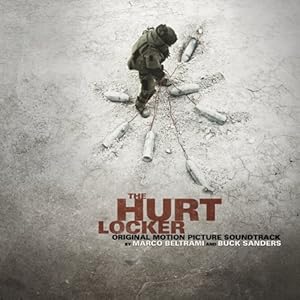
THE HURT LOCKER - Marco Beltrami & Buck Sanders
There were two scores from the 2009 Oscar Nominations that I'm glad I gave myself the chance to revisit so much later. James Horner's Avatar was the first, Marco Beltrami & Buck Sanders' The Hurt Locker is the other.
Directed by Point Break's Kathryn Bigelow, The Hurt Locker tells the story of three American soldiers on the Explosive Disposal unit, during the war in Iraq.
A score I had been eagerly awaiting for quite sometime, as Beltrami had never really composed for a war film before, The Hurt Locker, came as a complete disappointment at first.
I found it to be nothing more than a jumbled conglomeration of synth sounds, tweaked and pitch-shifted to make the ears bleed.
Giving it some time to age and repeated listens to study it some more, I found it to be so much more than that. Beltrami and longtime collaborator/soundscape artist, Buck Sanders sculpted one of the most intensely, disturbing avant-garde scores I think I've heard since Christopher Young's first 1987 Hellraiser score.
The score screams of extreme hostility from the very get go and hardly ever lets up from this unpleasantness, other than a few spots of lone depression, which isn't anymore comforting.
It attacks the senses with such precision and intensity, it's easy to see why the average score listener would hate it. It's not a fun listen at all, but it's perfect for such a film as The Hurt Locker and feels as if it's absorbed all the intensity on screen and is filtering it through your ears.
I don't know how they did it, but it's made quite obvious, through dissonant sounds and drones, which cues are meant to magnify the hostile dry, landscape that surrounds the characters and which ones rely heavily on angry, insane interiors of the minds of the main characters. How you would go on about personalizing sounds like that, boggles the minds as to how long it took the two composers to come up with what was interior and what would be exterior.
In an interesting twist, Beltrami & Sanders don't make use of the Iraqi instruments or voices by shoving the down the throats of the listeners, like Zimmer or any of his minions would do. They don't need to let the viewer know which country the film takes place in, by rocking out with an oud or a rebab to a hip hop beat. Instead, they mute the instrumentation and vocals to be heard in the background, almost as they're attempting to invade the characters heads over a wall of noise and insanity.
Not all is angry screeches and electronic pulses though. Interestingly enough, a Western like theme is created for the cowboy like main character, Sgt. James, deliciously played by Jeremy Renner. No stranger to beautiful Western music, Beltrami & Sanders craft a depressing, lonely little piece using an e-bow and 3 slightly different tones on an electric guitar.
This score is immensely threatening and makes no attempt to pretend to be anything but. Beltrami & Sanders took this project with a perfect approach with industrious "noise", when a straightforward musical score, would have made too much sense and by no means, are we or the characters to be making sense of such a situation.
The Hurt Locker is angry, noisy, depressing and constantly reminding the listener that you are alone...Beltrami & Sanders capture that perfectly.
It could have easily been nothing but a noisy synthesized mess with one slight misstep, but the two composers handled it so well and closely, it actually comes off as genius and well thought out.
At first, I figured their score was nominated solely because it was attached to 2009's darling film, The Hurt Locker (who would nominate something so avant-garde for an Academy Award?). Now I would like to believe it was nominated because it deserved it for capturing the feel of the film to a tee (doubtful still, but that's really why it deserves the nom).
Beltrami & Sanders' score is a very difficult listen that won't appeal to many, but if you have the patience for it, it is extremely rewarding as it twists your emotions into a tense knot of anger, confusion and takes you completely out of your comfort zone.
I love it.
*** 1/2
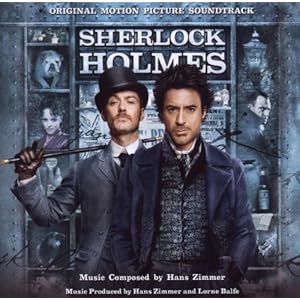
SHERLOCK HOLMES - Hans Zimmer
On paper, director Guy Richie tackling the Sherlock Holmes character in a new film seemed really weird. Casting Robert Downey, Jr. and Jude Law in the iconic lead roles seemed even weirder. Hiring composer Hans Zimmer on a Guy Richie project (most of all this project) sealed the deal as 'weird'.
...And the best part about such a project? It all worked out in the end.
Upon the first listen, the main theme sounds a lot like Jack Sparrow's theme from Pirates Of The Caribbean. Which can be forgiven, as both Holmes and Sparrow are comedic, eccentric and pompous characters that call for such a theme.
Here Zimmer focuses on a playful cimbalom and a famously detuned piano (which Zimmer threw down a flight of stairs) as the central instruments for Holmes' main theme. It works extremely well, as a wild, slightly off-kilter romp, with some mystery sprinkled into for obvious reasons.
Zimmer tosses in some bizarrely played solos by a screeching violin and fiddle, to boot there's also a drunken accordian jig, some tubas, a banjo and bagpipes and in a stroke of pure offbeat genius, the Westminster Chimes even makes an appearance.
For the most part, Holmes, sounds as if Gogol Bordello came along and covered The Pogues with an array of broken instruments. I don't know if this was intentional or not, considering Richie's close friendship with Gogol Bordello, but I'm suprised to see that I'm the first one to mention this.
I might go so far as to say Sherlock Holmes sounds like a certain type of pure madness, that usually comes attached to genius, which is perhaps what Zimmer was aiming for. The character of Sherlock Holmes was supposed to be a bit of a madmen, cursed with a generous amount of intelligence.
Holmes comes off as a style Zimmer does not visit often and I wish he would more often. It sprinkles in flavors of some of his previous efforts, including An Everlasting Piece, The Peacemaker and of course Pirates.
This score, like Mr. Fox, isn't for everybody. In fact, I'm willing to bet, most Zimmer fanboys who loved his work with Christopher Nolan, will be left confused and wondering where the "epic manboy" music is.
I love this score and quite frankly is an easy one to get excited about. It's fun, crazy and loud.
Let's hope Zimmer keeps on writing surprises like this more often.
****
UP - Michael Giacchino
I've all ready gushed over this score in an earlier post. So I should think it's quite obvious that I think Giacchino's UP should (and was) be the the winner of the Oscar for Best Score.
Since I've all ready expressed my feelings for this wonderful modern classic, why not post what other more respected score reviewers thought of it?
"Giacchino's UP gets a huge "thumbs up" from me. Big ups for not being afraid to return to "good, old fashioned" scoring techniques that have made classic animation features endure the tests of time and trend."
-Christopher Coleman, Tracksounds
"Giacchino's music, being completely acoustic and orchestral, has an organic nature to it which is refreshing in and of itself, but he goes one step further by employing colorful orchestral techniques and instrumentations which give his scores a completely delightful flavor."
-David Abraham Dueck, suite101
"Giacchino has done extremely well scoring Up, as it would have definitely been a difficult film to compose, since getting the mix of simple French street music and the grandiose of an orchestra to combine together is not an easy task, it has been done superbly and it has really captured the emotive pictures that are being projected onto the screen."
-Doug Belfast, Sputnik Music
"Buy it if your heart was broken by the tragic whimsy of Michael Giacchino's theme for the primary couple in the context of Up, its combination of vintage jazz and waltz rhythms both affably light-hearted and remarkably intimate at the forefront of the film's mix."
-Christian Clemmenson, Filmtracks
"Up is a wonderfully entertaining and enjoyable score, illustrating perfectly Giacchino's lighter, thematic side, and more than confirming his newly acquired status as one of Hollywood’s rising music stars."
-Jon Broxton, Movie Music UK
....
...I urge you to check this one out. URGE.
May 17, 2009
ANGELS & DEMONS music composed by Hans Zimmer

The Catholic Church should really learn to keep their mouths shut when it comes to something they disapprove of. By protesting a work of art or whatever you might call Dan Brown's Robert Langdon novels, they only made the general public more curious about the novels and it's in inevitable blockbuster film adaptations. The Catholic Church helped turn The Da Vinci Code, what should have only been a grocery store novel, into a worldwide best seller, with Harry Potter being the only book to outsell it in 2004. As of 2006, 60.5 million books were in print at a time and was rated 4 on the 101 Best Books Ever Written list...how? Blame the Catholics and the people who were curious what all the fuss was about. If that weren't enough, Ron Howard took it upon himself to direct Tom Hanks in a huge movie adaptation which only added fuel to fire for the Roman Catholic Church. By then you would have thought the Catholics would learn to shy away from any sort of protest of the film. They didn't and in doing so Howard's The Da Vinci Code film's opening weekend earned $77 Million worldwide, making it the seventh biggest movie opening in history to that date. By the end of year, after opening in May, The Da Vinci Code earned itself a staggering $758,239,851 worldwide. Inevitably, being Ron Howard's and Tom Hanks' most successful film at that time, a sequel was in the works. With no sequel actually written by Dan Brown, Columbia Pictures decided to work with Brown's previous novel, Angels & Demons which it's events occured before The Da Vinci Code, but they scratched that idea and in the film adaptation this story would come after.
Very much like the first film, Angels & Demons was attacked by the Catholic Church once again. This time around, I don't even think they reviewed the subject matter of the story, as Hanks' Langdon character aids the Catholic Church from attacks. I'm sure, Columbia pictures really didn't mind the controversy at all this time, as Angels & Demons has earned $152 million worldwide on it's opening weekend.
With Ron Howard and Tom Hanks having both returned for the film's sequel, it would only seem suiting to bring in The Da Vinci Code composer, Hans Zimmer, who received a Golden Globe nomination in 2007 for his original score. Zimmer is no stranger to the summer blockbuster score, with The Pirates Of The Caribbean trilogy, The Rock, Gladiator and Batman Begins & The Dark Knight (with James Newton Howard) under his belt.
The Da Vinci Code was a powerful and extremely effective score that is probably one of Zimmer's better works from the past ten years. The original score's shining star was "Chevaliers de Sangreal", a beautifully textured string composition that told a story of wonder and discovery through the music only. With this being the most popular cue on the album, Zimmer decided to continue with that theme when it came time to score Angels & Demons. He decided to try things a little different this time around and enlisted the help of violinist Joshua Bell, who had just played for Zimmer's pal James Newton Howard on Defiance in 2008. Things were looking good for Zimmer's new project.
"160 BPM" opens the album with a bang. A synthetic rhythm quietly builds up, like something from Zimmer's own Batman scores, then things get intense in a apocolyptic way, with an interesting layering of intimidating choirs chanting back and forth against eachother like they're channeling Carl Orff's Carmina Burana. With the electric bass, the drum pad rushing past you and a frantic string section frantically trying to keep up, "160 BPM" is brand new to the Robert Langdon world, just not ours. As interesting as the choral work is, the cue offers nothing new to the score world and kind of wanders around aimlessly after the three minute mark. The dedicated score collector will recognize "160 BPM" as nothing more than an updated reworking of Mike Oldfield's "Tubular Bells" (which was used as the theme for The Exorcist) or Goblin's theme for the 1977 horror cult-classic Suspiria.
The existing Robert Langdon theme is reintroduced briefly at the beginning of "God Particle" with Joshua Bell's hynotizing violin playing. This theme is all to brief, as Zimmer predictably dives into electronic ambience that can heard in almost all his scores from the past 10 years. Thankfully we are treated to a haunting solo piano at the tail of the five minute cue, which sounds almost as if it could have crawled right out of Zimmer's The Ring scores.
"Air" quickly establishes itself as one of the album highlights. Bell's violin plays in the cue, with a rich sound of loneliness and despair. A chilling chant slowly reverberates itself into the mix for a few moments and is suddenly cut-off by some of Zimmer's finest work to date for it's subtlety. It doesn't last for too long, as the choir and pounding percussion come in like they're ready to take on the gods...or God. The string work here is top-notch, displaying both sadness and intensity to perfection. Once again Zimmer finishes the cue off with a beautiful piano rendition of the main theme, played over some soft strings.
Nothing new is really introduced in "Fire". Infact it's a cue that shouldn't be a problem skipping. It's a simple, messy reworking of "160 BPM" only this time it's riddled with galloping drum pads, ridiculous electronics and church bells ringing to produce a more bombastic sound, which I guess will please any Zimmer fanboy prancing around in his mother's basement.
"Black Smoke" sneaks in almost unnoticed and I could only wish it had stayed that way, with it's electronic natterings that wouldn't be out of place in a Wesley Snipes film. Although there is some interesting drum and percussion work it's all too brief to really enjoy, especially over all the electric fluttering sounds.
After two incredibly lacking tracks, clocking in at about thirteen minutes combined, the album's biggest highlight is more than welcome, "Science & Religion". Zimmer once again playing it subtle, suceeds with a wonderul introduction from Bell's violin played over a sorrowful droning of synthetic woodwinds. The cue begins to build upon itself with a glimmer of hope and wonder, with Bell's playing still in the spotlight and a string section and synthetic angelic choir used to perfection. Around the eight and a half minute mark, Zimmer decides to revisit and rework the peaceful subtheme he uses at the ending of The Thin Red Line's Journey To The Line cue. As it introduced the cue, Bell's violins plays it out as well with a tenderness that begs the listener to actually think and not just listen.
"Immolation" is the biggest insult to the listener, especially coming after "Science & Religion". It's nothing but 3 and a half minutes of low bass drones rocking back and forth, which ultimately builds up to an angelic choir at the end, but still has nothing to really give the listener to think or care about.
"Election By Adoration" takes us back to a slower rendition of the "Chevaliers de Sangreal" theme, played like a violinist's requiem. Zimmer could have easily bowed out gracefully with this track....but, unfortunally he doesn't.
Along comes "503", which I suspect should have been the highlight of the score, but if comes off as forced and awkward. It's basically the original "Chevaliers de Sangreal" theme played weakly and watered down, with Joshua Bell's violin playing over top of it and I mean that when I say that. On paper it must have sounded like a great idea...the end product is not.
For the die-hard Zimmer/Angels & Demons fan, a bonus cue titled "H20" is available free of cost for downloading on the official Angels & Demons soundtrack website. For the casual fan, it's not worth the simple trouble and offers nothing new to the album.
In the end, Zimmer has written some wonderful cues for Angels & Demons and he has written some stark, electronic excuses for score music as well. For the more classical score collector, Angels & Demons will be a so-so album, with maybe 2 or 3 cues worth multiple listens. To the Zimmer fanboy or girl, I'm sure this album will be the talk of town for it's bombastic movie trailer like music and simply just the name Hans Zimmer (who's fans seem to pratically worship as a god). Although Angels & Demons is a continuation of The Da Vinci Code, Zimmer doesn't quite live up to the original's beauty and richness (with the exception of "Air" and Science & Religion"). Instead he goes for the safer, easier route of composing for the same people that believe The Dark Knight score is the new bible.
Up next for Zimmer, is Guy Ritchie's Sherlock Holmes, hopefully it will be more like the almost perfect Frost/Nixon (which his fans never seem to mention) and less like his countless list of bombastic action scores. With Frost/Nixon and a few moments on Angels & Demons, Mister Zimmer has proven that he can write quietly with grace...he just doesn't seem to want to do it.
* * * out of 5
Subscribe to:
Posts (Atom)